


Why do some people accumulate wealth while others struggle to make ends meet? It’s not just luck, inheritance, or intelligence. One of the biggest differences comes down to mindset. The way rich people think, decide, and act often contrasts sharply with how the poor and middle class approach life, money, and opportunity.
Authors, self-made millionaires, and decades of research point to a consistent truth: your mindset determines your financial destiny. Let’s break down the differences between the rich mindset vs poor mindset, backed by real-world examples and insights from some of the most successful people in history.
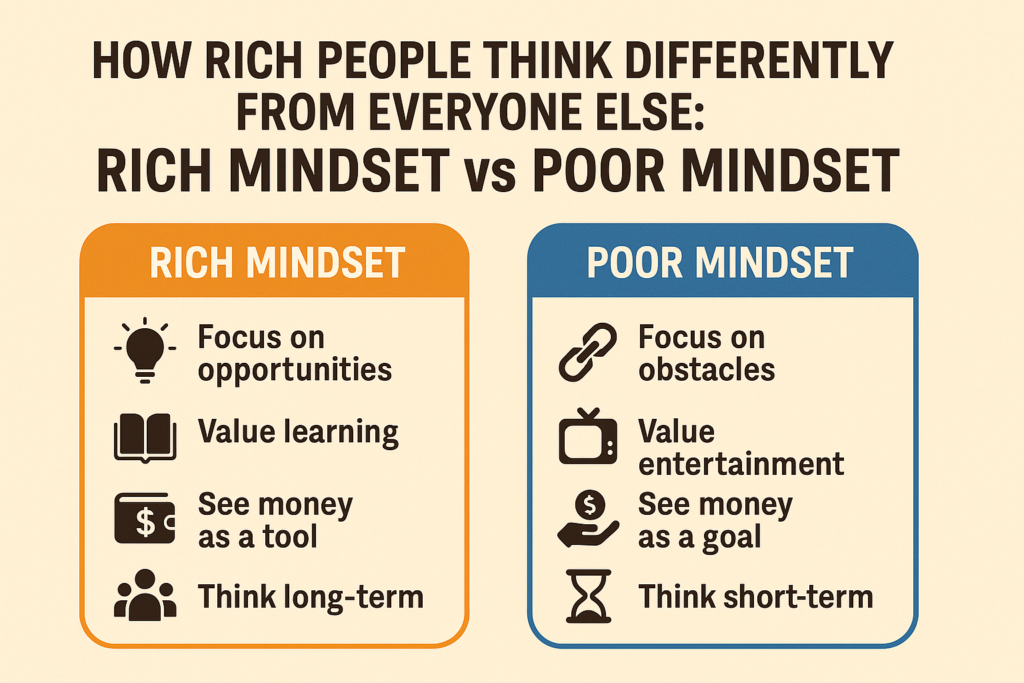
1. Rich People Think in Terms of Opportunities, Not Obstacles
A poor mindset often asks: “What could go wrong?”
A rich mindset asks: “What’s possible if this goes right?”
- Example: Elon Musk risked much of his PayPal fortune to launch Tesla and SpaceX, betting on future opportunity rather than fearing failure.
- Book Insight: In The Magic of Thinking Big by David J. Schwartz, successful people consistently visualize the potential upside, while unsuccessful people focus on limitations.
This doesn’t mean the wealthy ignore risks—they calculate them. But they see problems as challenges to solve, not reasons to quit.
2. Rich People Value Learning Over Entertainment
Wealthy individuals see knowledge as an investment. The poor mindset often prioritizes comfort and instant gratification.
- Fact: According to a study cited in Rich Habits by Thomas Corley, 88% of wealthy people read 30 minutes or more each day, compared to only 2% of poor people.
- Example: Warren Buffett spends about 80% of his day reading and analyzing information.
Instead of asking, “How can I pass the time?” the rich mindset asks, “How can I use this time to grow?”
3. Rich People Believe Money Is a Tool, Not a Goal
Poor mindset: “I want money so I can spend it.”
Rich mindset: “I want money so I can create freedom, security, and opportunities.”
- Robert Kiyosaki, author of Rich Dad Poor Dad, explains that the wealthy use money to build assets that work for them—investments, businesses, and real estate—while the poor often spend money on liabilities like cars, gadgets, and short-term pleasures.
- Rich people focus on cash flow. Poor people focus on paychecks.
4. Rich People Network Intentionally
The rich understand that your network is your net worth. Poor mindset often thinks networking is fake or unnecessary.
- Fact: In a survey by Harvard Business Review, 85% of jobs are filled through networking. The wealthy take this concept further by cultivating relationships with mentors, investors, and other high achievers.
- Example: Oprah Winfrey attributes much of her success to surrounding herself with other ambitious people and learning from them.
The rich mindset asks: “Who can I learn from? Who can I collaborate with?”
5. Rich People Think Long-Term
Poor mindset looks for immediate rewards. Rich mindset is willing to delay gratification.
- Example: Jeff Bezos built Amazon with little profit for years, reinvesting earnings to scale. That long-term patience turned Amazon into a trillion-dollar empire.
- Research: The famous “Marshmallow Test” from Stanford showed that children who delayed gratification ended up more successful later in life.
Poor mindset says: “I’ll take what I can get now.”
Rich mindset says: “I’ll build something that pays me later.”
6. Rich People Focus on Multiple Streams of Income
Poor mindset often relies on one paycheck. Rich mindset looks for ways to diversify.
- Fact: A report from IRS data shows that millionaires usually have 7 or more income streams, including investments, businesses, royalties, and real estate.
- Example: Jay-Z built his fortune not just from music but from investments in art, liquor brands, real estate, and streaming platforms.
The poor ask: “How can I earn more at my job?”
The rich ask: “How can I make money work for me in different ways?”
7. Rich People See Failure as Feedback
Poor mindset fears failure and avoids risks. Rich mindset views failure as a stepping stone.
- Example: Richard Branson has launched hundreds of businesses—many failed, but he treats each as a learning experience.
- Book Insight: In Think and Grow Rich by Napoleon Hill, failure is described as a temporary defeat, not a permanent condition.
The poor mindset sees failure as an identity. The rich mindset sees it as a teacher.
Final Thoughts: Adopting a Rich Mindset
You don’t need to be born into wealth to think like the rich. Many millionaires and billionaires started with nothing but a mindset shift:
- Focus on opportunities, not limitations.
- Invest in learning and self-growth.
- Treat money as a tool, not a toy.
- Build networks and multiple income streams.
- Play the long game, even if it means short-term sacrifice.
As Steve Siebold, author of How Rich People Think, writes:
“The rich think about money logically, while the poor see it emotionally.”
By shifting your perspective, you can rewire your financial future. Wealth begins in the mind long before it shows up in the bank.
Leave a Reply